Religious Life of Senno District
Senno district has a rich religious heritage where Orthodox, Catholic and Jewish communities coexisted for centuries.
FRANCISCAN CHURCH
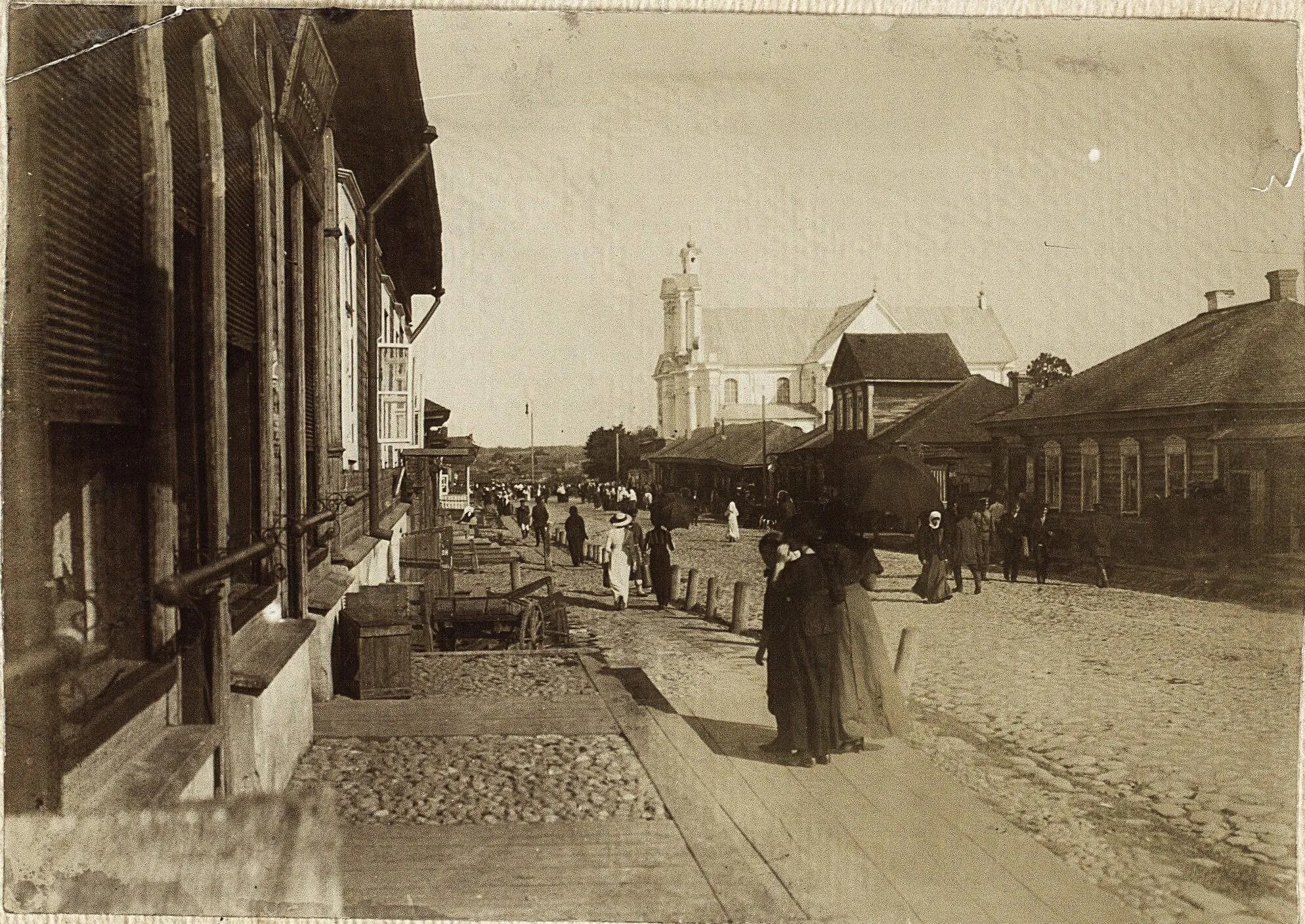
Church Foundation
In 1609, through the efforts of Eustachy Kurcz, the first church was built in Senno for the conventual Franciscans. It bore the name of Francis of Assisi, the founder of the order.
Rebuilding in Stone
In 1772, by order of the then owners of the city, Tadeusz and Jadwiga Załuski-Ogiński, the wooden church building was replaced with a brick one in the late Baroque style and consecrated in honor of the Holy Trinity. In the same year, at the request of this family, the relics of Saint Fortunatus were transferred here from Rome. Permission for this was obtained from Pope Clement XIV.
Monastery Complex
In 1809, a residential stone monastery building was built on the west side of the church.
It is known that the monastery had a library and a school operated there.
Church Interior
The church was decorated with wall paintings made by Wacław Bubnowski at the beginning of the 20th century.
It is also known that a crypt was equipped in the basement of the church, where coffins with the remains of clergy and nobility of the Senno poviat stood.
History of Destruction
In 1864, the Franciscans were expelled from the church, after which an episcopal church remained.
The parish in Senno ceased to exist in 1937, when the last priest was taken away from here. Later it was used as a warehouse.
And on September 17, 1962, the 18th-century monument, which was the face of the city, was blown up...
Later, a restaurant was built on this holy place for the residents of Senno.
Parish Revival
After a long period of persecution of believers, a period of revival began.
In 1998, services were held in the sports complex building by the parish priest of the Lepel parish of St. Casimir, Father Mieczysław Janchishin from Lepel. Six people gathered for this mass: gradually the parish community began to revive.
On March 28, 2001, the parish under the title of the Most Holy Trinity in Senno was officially registered.
Modern Church
In 2014, Father Michał Jermaszkevich began his ministry in the parish.
At first, there were attempts to build a new temple where the old stone church used to be, or to carry out a complete restoration. But part of the former church territory was given over to parking.
Then the idea arose to build a replica of the destroyed historical monument on a reduced scale.
On September 9, 2019, the site for the church was cleared and by winter the walls were erected. On September 17, 2022, the consecration of the newly built Church of the Most Holy Trinity took place, performed by Bishop Oleg Butkevich of Vitebsk.
Architecture of the Modern Church
This is a replica of the old stone church and as close as possible to the original in terms of the facade.
In terms of area, it is 9 times smaller - three times smaller in height, width and length.
The church is located in the area where the foundations of the old church's sacristy were.
The modern Church of the Most Holy Trinity is located at: Krasny Oktyabr street.
ST. NICHOLAS CATHEDRAL
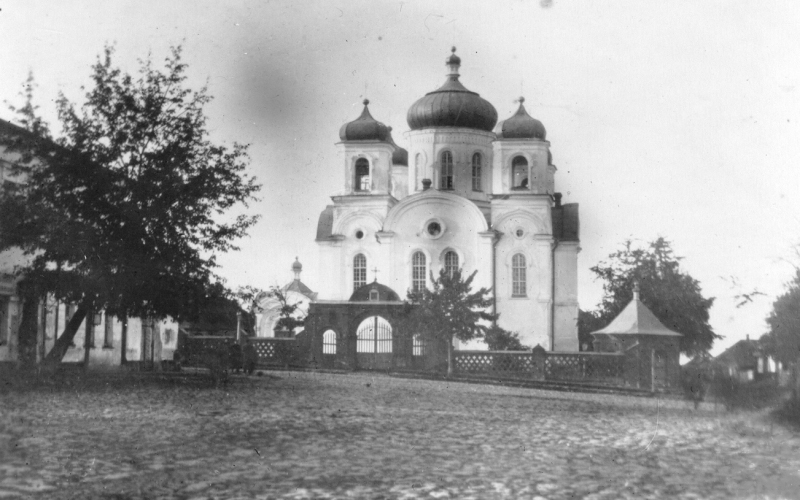
Location
Minsk Street led to the square where administrative buildings were located: the treasury, police department, city administration building. In 1867, on the site of the former Uniate Church of Elijah the Prophet, a stone St. Nicholas Cathedral was built on Vetrenaya Street. The cathedral faced the square with its main facade.
Architecture of the Modern Church
The temple was built in the pseudo-Russian style, that is, in the old style. The bell towers on both sides of the naves were arranged in the form of towers with three tiers. It was a cross-domed temple with five onion domes, the largest of which had a complex shape and rose in the center. 3-tiered 4-sided bell towers on both sides had one separate opening each. All window openings had the shape of curved semi-circular arches, above which were round window openings-lucarnes. The walls of the building were divided by pilasters and cornices. Next to the cathedral in 1889, a stone chapel was built in memory of the happy salvation of the imperial family on October 17, 1888, when the People's Will revolutionaries tried to kill Alexander III on the Kharkov railway.
Interior
K.T. Ankievich reports on the interior decoration of this temple:
"... among the icons in the Cathedral, an elegant icon of St. Alexander Nevsky in a painted icon case, sent as a gift by Emperor Alexander III after the first attempt on his life in 1866, attracts attention. The Cathedral also carefully preserves the monstrance, received from the sovereign for the eternal commemoration of the soul of the deceased Tsarevich Grand Duke Nicholas Alexandrovich."
The cathedral was decorated with sculptures of Alexander Nevsky and Dmitry Donskoy, made by master Karp from Ulyanovich.
Territory
The church territory was surrounded by a wooden fence with brick pillars. On the left side there was a shop where candles and church books were sold.
History of Destruction
In 1934, by decision of the Bolsheviks of the Senno District Party Committee, the cathedral was dismantled into bricks, from which the House of Culture was built. And in place of the cathedral, a park was arranged with a monument to V. Lenin and I. Stalin in the center.
In 1961, a school building was erected on the empty site after the demolition of the cathedral.
INTERCESSION OF THE THEOTOKOS CHURCH
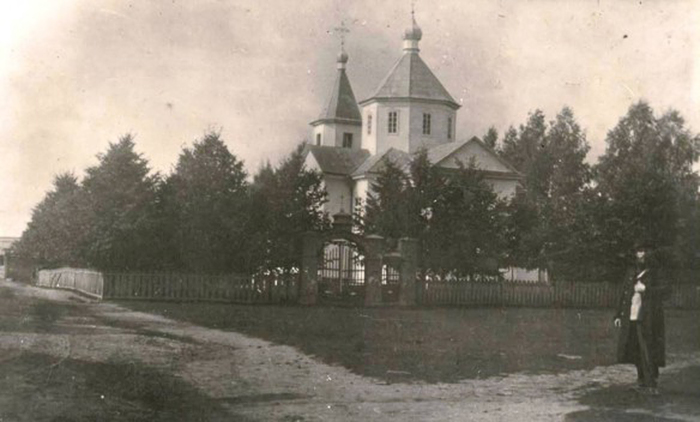
Church Foundation
The wooden Orthodox Intercession Church was built in 1859 by Ksavery Wojciechowicz Pusłowski – one of the richest local landowners and owners of the city.
Location
The church was built in the folk wooden style with elements of classicism. It was a parish church that stood in the planning center of the city and was intended for the rural population of Senno district, the poorest strata.
Architecture of the Modern Church
The church was a three-log church, elongated by an axial composition with two domes. Throughout the length of the building there was a nave, which intersected across with another nave - a transept. Next was the apse, made in the form of three-four-sided projections. The entire space of the church - the narthex, altar and apse, was covered with one gable roof with a pediment over the apse, transept and narthex.
On the left side there was a sacristy, a small room at the altar part where church items were stored. The plan of the church was an elongated cross. At the intersection there was an octagonal drum with eight window openings, a tent completion and a small head in the shape of an onion.
Above the narthex rose a second drum in the shape of a quadrangle with sloping corners, with four window openings, a tent completion and an onion-shaped head. This is where the bell tower was located, painted blue with green domes. The windows had a classic rectangular shape and were decorated with platbands with pediments.
Territory
The church territory was planted with linden trees in two rows and surrounded by a wooden fence, creating a harmonious architectural ensemble.
History of Destruction
The church was closed on August 3, 1936. After closing, there was a flour warehouse in the building for a long time. In 1939-1940, the building was destroyed.
After World War II, a sports complex SSh №2 was built on the site of the temple, and in 1972 a new building was erected, which now houses the editorial office of the regional newspaper "Golas Sennenshchyny".
From the newspaper "Mogilev Diocesan Gazette"
"The Most Holy Governing Synod heard: the proposal of the Synodal Chief Procurator, dated February 27, 1887, No. 3284... on the elevation of the St. Nicholas Church in the city of Senno to the status of a cathedral..."
The St. Nicholas Church in Senno was elevated to the status of a cathedral with an increase in the composition of the church clergy and maintenance. The Synod recognized the petition of the Mogilev Diocesan Administration as worthy of respect.
Travel Notes of Bishop Mikhail
"The city of Senno is located on Lake Senno, at the small river flowing into it, 147 versts from Mogilev. There has been no bishop's visitation there for 12 years. This is a city with a predominantly Jewish population and Roman Catholic faith. Many Catholic gentry live in the surrounding villages, and almost all landowners are Catholics."
Orthodox churches of Senno
St. Nicholas Cathedral: stone, beautiful on the outside, painted with oil paint with paintings of icons and ornaments on the inside. The temple has limited capacity - most worshipers on Sundays and holidays are forced to stand on the porch. Parishioners - 2696 souls of both sexes. The clergy consists of 5 people: a protopriest, a priest, a deacon and two psalm-readers. Church utensils and vestments are in sufficient quantity. The library is good, the choir is well organized.
The church has 75 acres of land (suitable and unsuitable). There are no state-owned premises for the clergy, the maintenance of the clergy members is moderate. The clergy is characterized as efficient and reliable. Church documents are kept accurately. There are 5 church schools operating in the parish, in which 113 boys and 19 girls studied. The church-parish trusteeship operates to the best of its ability.
Intercession Church: wooden, located on the outskirts of the city. Utensils and vestments are mediocre. Parishioners - 2437 souls of both sexes, living scattered in 30 villages at a distance of 3-10 versts from the church. Through the efforts of the parishioners, the temple was repaired. The clergy is two-membered. Church land - 36 acres. The house for the priest is parish-owned, suitable for living, and the house for the psalm-reader is dilapidated and unsuitable.
Catholic church
Stone, very spacious, built in the best place of the market square. Over 6000 souls of parishioners are assigned. On the feast in honor of Fortunatus on July 4, up to 10 thousand Catholics gathered.
Memorial Book of the Mogilev Province
Statistical data on places of worship in the city of Senno and its district represent a complete picture of the religious infrastructure of the region, where each denomination has its own definite place and significance.
Orthodox churches and monasteries
The Orthodox Church has the most developed network of places of worship. In Senno there are one stone and one wooden church, as well as one stone and one wooden chapel each. In the district there are 63 Orthodox churches: 8 stone and 55 wooden, which indicates the predominance of wooden architecture in rural areas. Also in the district there is one stone monastery and 16 wooden chapels.
Roman Catholic churches
The Catholic community of the region is represented in Senno by one stone church. In the district there are 4 stone churches. A feature of Catholic presence are chapels: 3 stone and 5 wooden are registered in the district. There are no Catholic monasteries either in the city or in the district. There are no wooden Catholic churches in the region.